
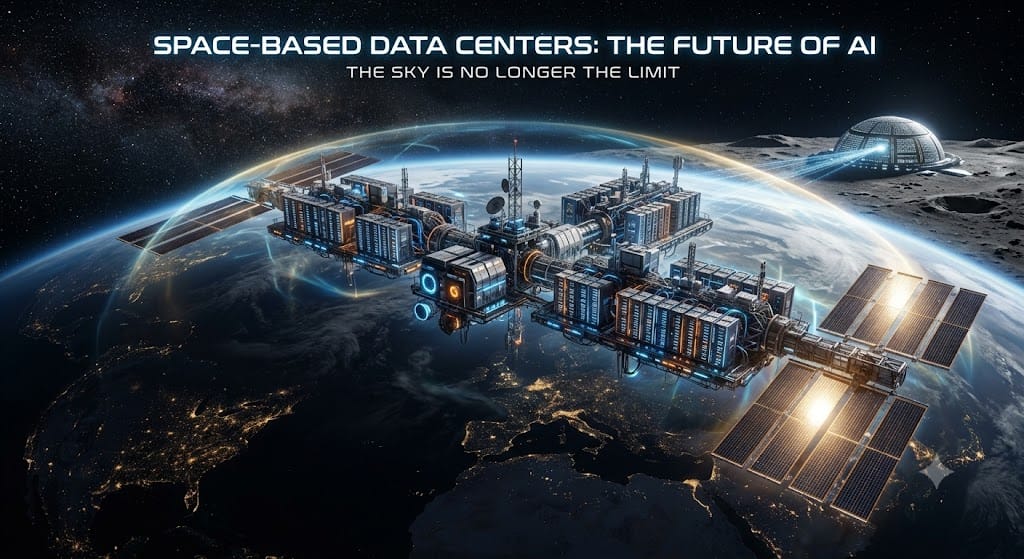
The Space-based data centers have moved from science fiction to funded hardware in orbit. With AI devouring Earth’s power grids, the sky is no longer the limit; it is the solution.
In November 2025, a small satellite launched by a Washington-state startup began running an AI model in orbit for the first time in history. The satellite Starcloud-1 carried an Nvidia H100 GPU and successfully executed inference queries on Google’s Gemma language model, proving that space-based compute is not a thought experiment but an operational reality. Within months, the company raised $170 million, hit a $1.1 billion valuation and filed for a constellation of 88,000 satellites with the FCC.
The driving force is a crisis unfolding on the ground. The AI boom is straining power grids, exhausting permits and igniting community opposition to new data center sites. Every model trained and every query processed demands megawatts of continuous power. Land is scarce, cooling water is finite and permitting now takes years. The industry is literally running out of planet.
“Orbital compute offers a way forward that respects both technological ambition and environmental responsibility.”
Phil Johnston, CEO, Starcloud
Space by contrast offers everything a data center needs in virtually unlimited supply. In sun-synchronous low Earth orbit, solar arrays receive uninterrupted sunlight around 90 percent of the time no grid connections, no fuel deliveries and no backup generators. Cooling the highest operating cost on Earth, is nearly free: heat radiates passively into the near-absolute-zero vacuum. There are no zoning boards, no land prices, no physical ceiling on expansion. The physics it turns out strongly favour the orbit.
The race is now fully underway. At GTC 2026, Nvidia CEO Jensen Huang declared that “Space computing, the final frontier has arrived,” unveiling its Space-1 Vera Rubin Module delivering 25 times more AI compute for orbital environments with partners including Axiom Space and Planet Labs. SpaceX filed FCC plans for millions of compute satellites. Blue Origin announced TeraWave, a 5,400-satellite data center constellation. China revealed a state-coordinated 200,000-satellite network focused on sovereign AI processing. In under 18 months, a startup white paper has become a geopolitical frontier.
The obstacles are genuine: radiation hardening, thermal management in a vacuum, launch economics not yet at parity with ground infrastructure and a sky filling with satellites faster than regulators can respond. Cost competitiveness likely requires Starship-era launch prices and will not arrive before 2028 at the earliest. Even optimists project space compute at under one percent of new capacity this decade.
Yet the trajectory is hard to argue with. The same energy and land constraints that make terrestrial scaling so painful grow more acute with every new AI model. Space-based data centers are already real, funded and backed by the most powerful hardware company on Earth. The cloud was always too small a word, for what is coming.
Hasitha Dissanayake – Solutions Engineer