
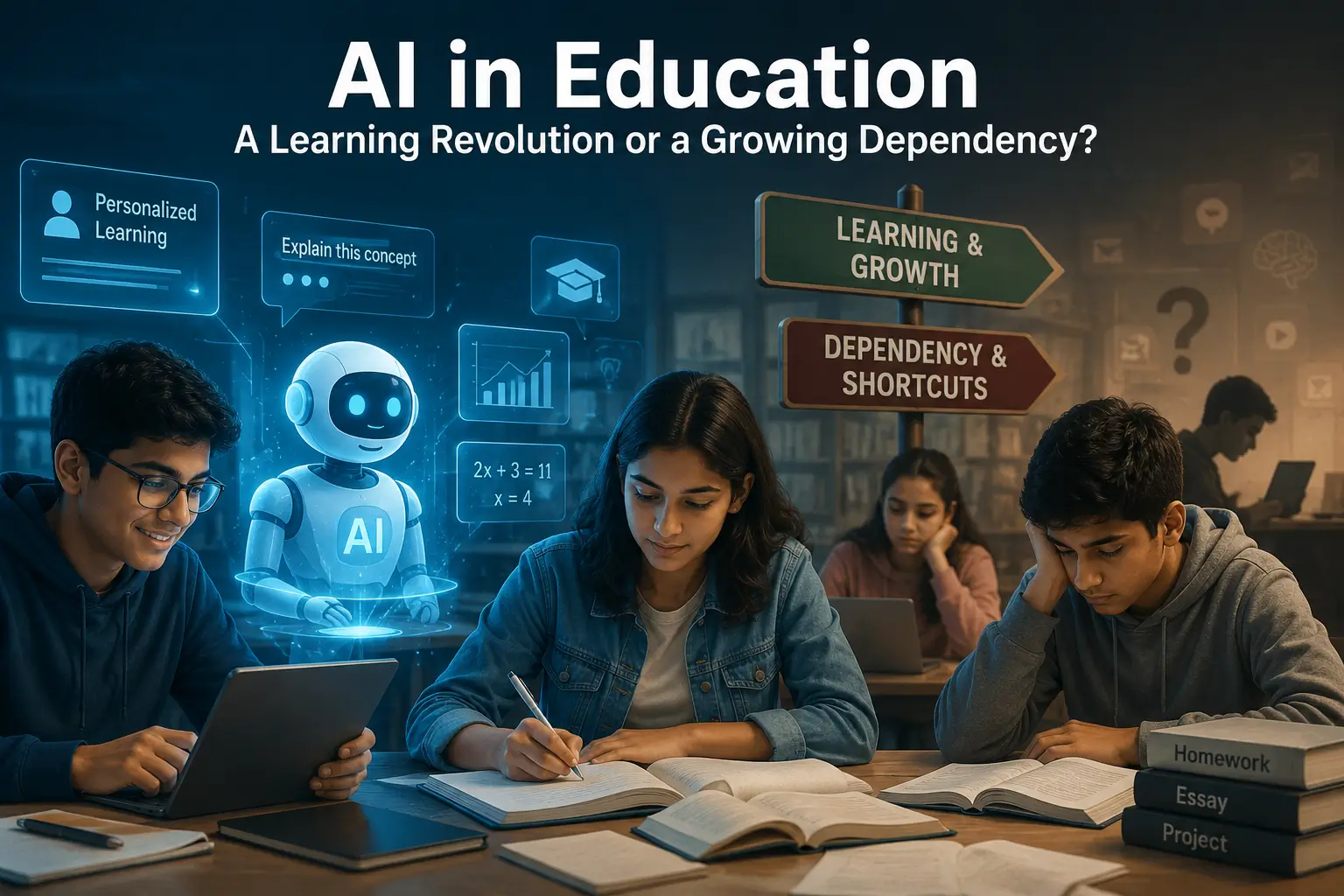
It’s the question on every teacher’s mind and every student’s search bar lately. From ChatGPT to smart tutoring apps, Artificial Intelligence has officially entered the classroom, and there’s no turning back. But as we move from physical textbooks to digital prompts, a massive debate is unfolding.
Is this technology a “super-tutor” that can personalize your education and explain complex physics in seconds, or is it a “digital crutch” that’s making us lose our ability to think?
In this post, we’re diving into the real impact of AI in education. We’ll explore how it can boost your grades and simplify your study sessions, while also looking at the hidden traps every student needs to avoid.
Here is the truth about AI and the future of learning.
Artificial intelligence is becoming a big part of education, and many students now use AI tools to study, write, research, and solve problems. This has created an important question: Can artificial intelligence really help students learn better? The answer is yes, but only when it is used in the right way.
One of the biggest advantages of AI is that it can make learning more personalized. Not every student learns at the same speed. Some need extra explanations, while others are ready for more advanced work. AI tools can adjust to these needs by giving simpler explanations, extra practice, or more challenging tasks. This helps students learn in a way that suits them better.
AI also gives quick feedback. Instead of waiting for a teacher to check answers, students can get instant corrections and explanations. This is especially useful in subjects like mathematics, grammar, coding, and language learning. Fast feedback helps students understand mistakes immediately and improve more quickly.
Another benefit is accessibility. AI can help students who face language difficulties or learning challenges. Features like translation, speech-to-text, text-to-speech, and simplified explanations can make education easier for many learners. In this way, AI can make learning more inclusive.
At the same time, AI has some risks. If students depend on it too much, they may stop thinking for themselves. Learning is not just about getting answers; it is about understanding ideas and developing problem-solving skills. AI can also sometimes provide wrong or misleading information, so students must learn to check facts carefully.
There is also the issue of misuse. Some students may use AI to complete assignments without doing the actual thinking. This can lead to poor learning and questions about academic honesty. That is why AI should be used as a support tool, not as a shortcut.
In the end, artificial intelligence can definitely help students learn better. It can make learning faster, easier, and more flexible. However, it works best when combined with human teaching, critical thinking, and responsible use. AI should not replace effort or teachers. Instead, it should be used to support students and help them become better learners.
Deminda Dilan – Tech Lead – Network & Security