
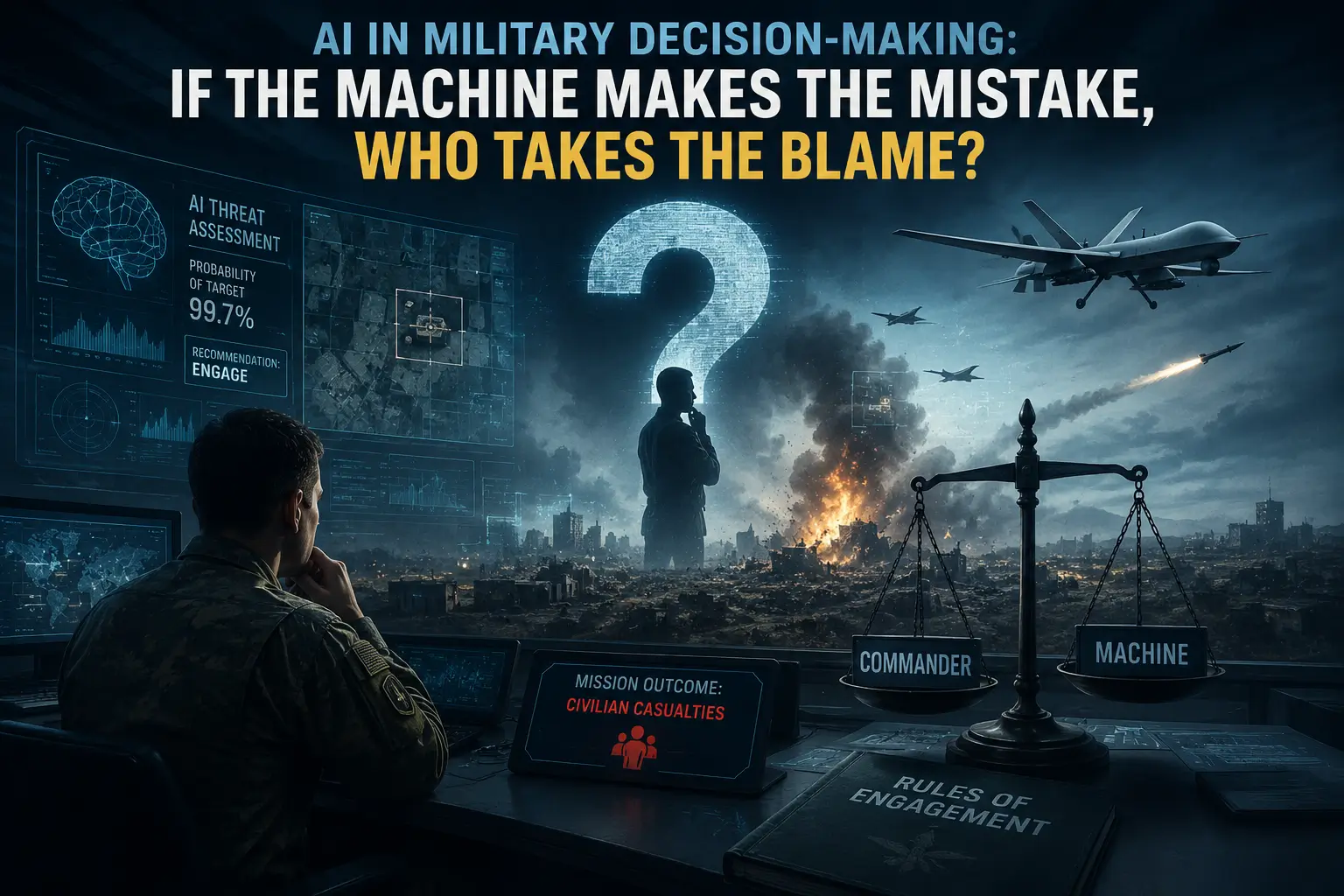
Artificial intelligence is rapidly changing the way militaries analyse information, assess threats and make decisions. AI can process enormous volumes of data far faster than humans and potentially help commanders identify patterns that might otherwise be missed. But this creates a fundamental question: when AI is involved in military target selection and something goes wrong, who takes responsibility?
A machine does not carry moral, legal or professional responsibility. It cannot stand before a military inquiry, a court or history and explain why it made a particular recommendation. Ultimately, responsibility must remain with human decision-makers. This is why AI in military operations cannot simply be treated as another technological upgrade. Target selection can involve incomplete intelligence, deception, civilian presence, rapidly changing circumstances and uncertainty. An algorithm may identify a target based on available data, but it may not fully understand the operational context behind that data.
The danger is therefore not only that AI can make a mistake, but that humans may place excessive confidence in an AI-generated recommendation. This brings us back to the larger question of trust. Militaries need to determine clearly where AI can assist, where its recommendations must be challenged, and where human judgement must remain decisive. There must also be a clear chain of accountability. If a commander approves an AI-assisted recommendation, responsibility cannot simply be transferred to “the algorithm.” Human beings remain accountable for decisions taken under their authority.
AI can become a powerful force multiplier for modern militaries, but only if technological capability is accompanied by human oversight, professional judgement, legal compliance and clearly defined accountability. The future should not be about AI replacing commanders. It should be about commanders becoming better informed through AI, while retaining the responsibility to decide. Because when the machine gets it wrong, someone human will ultimately have to answer for it.
Nalin Herath – Senior Business Development Manager – Defense