
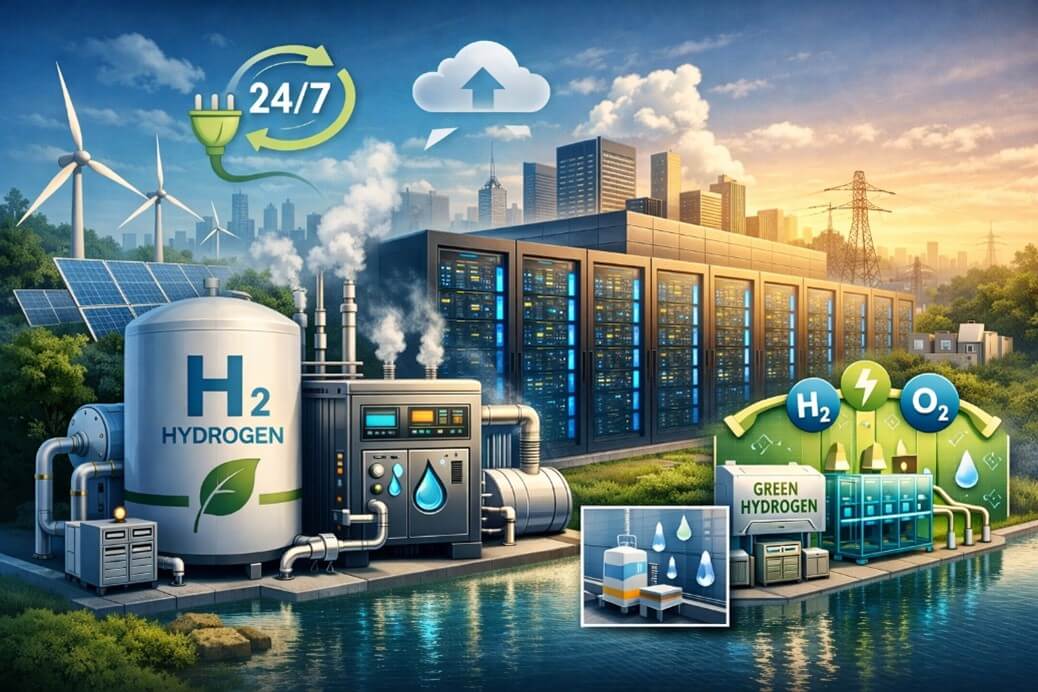
As the world accelerates toward a more digital future, one question is becoming impossible to ignore: how do we power the infrastructure behind that future sustainably?
Data centers are the invisible backbone of modern life. Every email sent, every video streamed, every online transaction completed, and every cloud-based application used depends on these energy-intensive facilities. As digital demand continues to grow, so does the environmental burden of keeping this infrastructure running. The source material highlights that data centers already account for roughly 1% of global electricity consumption, and that figure is expected to rise as AI, cloud computing, and always-on digital services expand.
This is where hydrogen enters the conversation in a meaningful way.
Hydrogen fuel cells offer a compelling alternative for powering data centers, especially where reliability is critical. Unlike intermittent renewable sources alone, hydrogen can support continuous, stable power delivery. In a fuel cell, hydrogen combines with oxygen to generate electricity, producing heat and water vapor as by-products rather than harmful emissions. For data centers, where uninterrupted uptime is essential, this creates an interesting bridge between sustainability and operational resilience.
What makes this especially relevant is that hydrogen is not merely being discussed in theory. The source notes that Microsoft tested hydrogen fuel cells to power a row of data center servers for 48 consecutive hours, demonstrating that hydrogen has real potential as a replacement for conventional diesel backup systems. It also points to wider interest across the technology sector as companies seek around-the-clock carbon-free energy solutions.
The bigger opportunity lies in green hydrogen. Not all hydrogen is environmentally equal. When hydrogen is produced from fossil fuels, much of its sustainability value is lost. However, when it is generated through electrolysis using renewable electricity, it becomes a far more credible clean-energy option. This creates a powerful future scenario: renewable energy can be used not only directly, but also stored in the form of hydrogen and later converted into reliable power when needed. That storage capability is particularly valuable for data centers, which cannot afford variability in supply.
From a strategic standpoint, hydrogen could reshape how we think about digital infrastructure. It is not just about reducing carbon emissions. It is about improving energy security, reducing dependence on diesel-based backup systems, and enabling cleaner long-duration storage for mission-critical operations. In regions where grid reliability is a challenge, hydrogen may also support more resilient and decentralized data infrastructure models.
There are, of course, real barriers. Hydrogen infrastructure is still developing. Storage, transport, safety management, and cost remain practical concerns. There are also efficiency losses in producing hydrogen and then converting it back into electricity. Yet these limitations should be seen in context. Many emerging technologies appear commercially difficult in their early stages, but become increasingly viable as ecosystems mature, investment grows, and scale improves. The same pattern may well apply here.
Another important point is that hydrogen-powered data centers could create value beyond electricity generation alone. The source notes that waste heat from fuel cells could potentially be reused for nearby buildings, while water vapor could support cooling-related applications within the facility. In the right environment, this opens the door to more integrated and efficient infrastructure design.
For business leaders, policymakers, and technology planners, the message is clear: sustainable digital growth will require more than software innovation. It will also require energy innovation. As enterprises scale AI workloads, governments digitize citizen services, and telecom and cloud ecosystems continue to expand, the pressure on data center infrastructure will only intensify. Hydrogen may not be the only answer, but it is increasingly looking like one of the most serious options for greening the digital backbone of the global economy.
The future of the internet will not be shaped only by faster networks, smarter algorithms, or larger cloud platforms. It will also be shaped by the energy systems that make all of that possible.
And in that future, hydrogen deserves serious attention.
Sameera Nissanka – Head of Technology & Delivery