
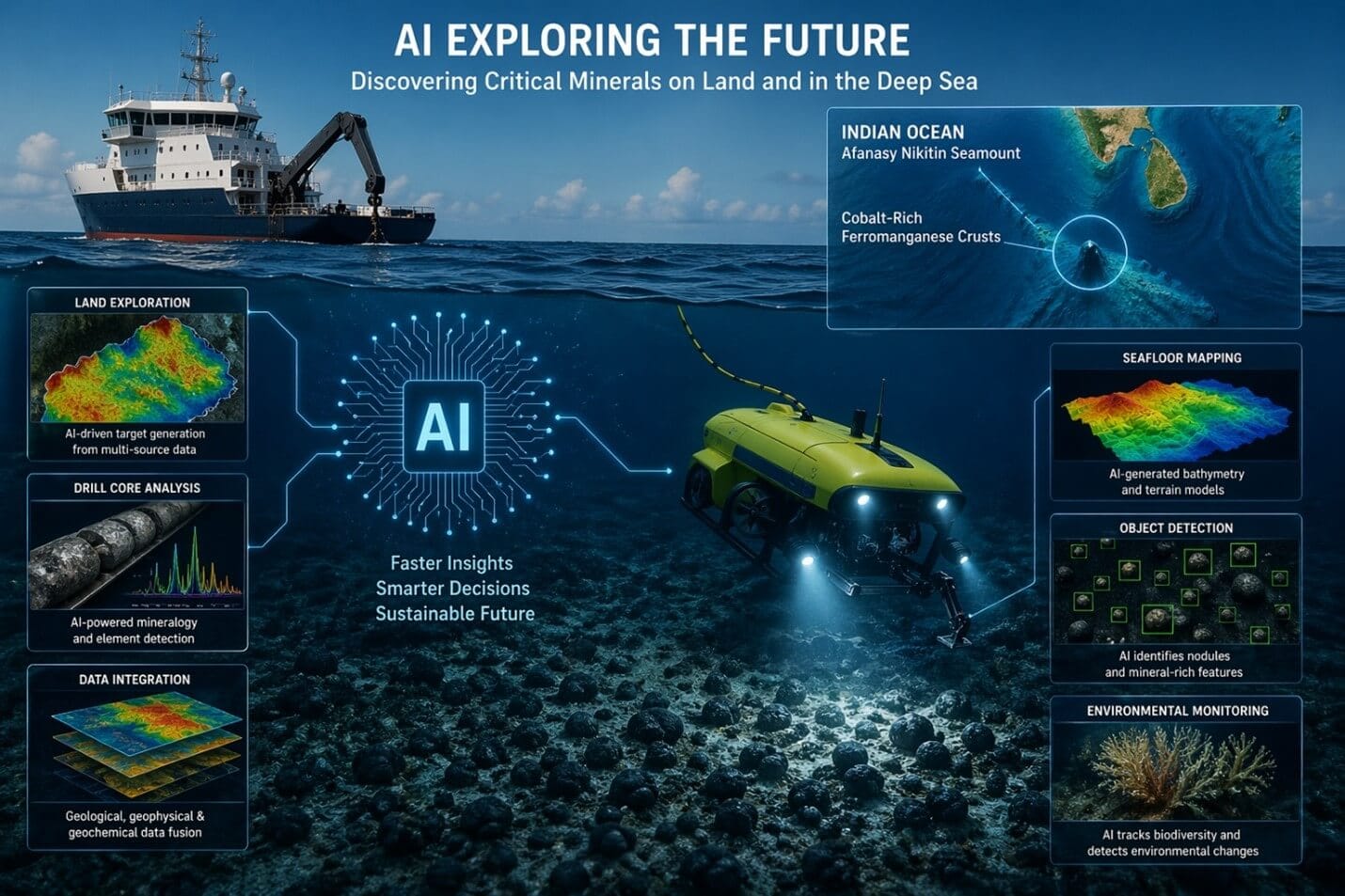
Recent attention on the cobalt rich Afanasy Nikitin Seamount in the central Indian Ocean, near an area linked to Sri Lanka’s extended continental shelf claim, has pushed seabed minerals back into the regional spotlight. India’s move to seek exploration rights for cobalt-rich ferromanganese crusts in that area, and Sri Lanka’s objection that the zone falls within its own pending continental shelf submission, shows that critical minerals are no longer only a geological issue. They are now deeply connected to energy security, maritime strategy, industrial policy, and geopolitics.
This matters because the world’s demand for critical minerals is accelerating. Cobalt, lithium, nickel, copper, graphite, and rare earth elements are central to batteries, electric vehicles, renewable energy systems, digital devices, and defense technologies. As governments and industries compete to secure long-term access to these materials, exploration is becoming more urgent, more data-intensive, and more expensive. That is exactly where artificial intelligence is starting to change the game.
Traditionally, mineral exploration has relied on geological surveys, field mapping, drilling, geochemical sampling, and years of expert interpretation. AI does not remove the need for that expertise, but it dramatically improves the ability to process vast amounts of data and detect patterns that would otherwise take much longer to identify. Today, AI models are being used to combine geological, geophysical, geochemical, satellite, hyperspectral, and historical exploration datasets to generate more accurate exploration targets and prioritize the most promising zones. Reviews of current mining-sector practice show that AI is already being used in prospectivity mapping, drill-core interpretation, and resource modelling, although results still depend heavily on data quality and domain expertise.
On land, this shift is already visible. AI-supported exploration companies are using machine learning to predict where critical mineral deposits are likely to be found, reducing time and cost while improving targeting accuracy. Sensor-rich workflows are also becoming more common, where drill cores and rock samples are scanned with imaging, spectral, and elemental tools and then interpreted using AI models. This allows exploration teams to move faster from raw drilling data to actionable geological insight. The result is not just better exploration efficiency, but a more strategic approach to mineral discovery in an era where easy deposits are becoming harder to find.
At sea, AI is becoming just as important, but in slightly different ways. Deep-sea mineral exploration generates enormous volumes of underwater imagery, sonar readings, terrain data, and environmental measurements. AI is increasingly being used to map the seabed, detect polymetallic nodules and cobalt-rich crust features, classify habitats, guide autonomous underwater vehicles, and support environmental monitoring. The International Seabed Authority has explicitly highlighted machine learning and advanced technologies as important for monitoring, predictive modelling, and scientific understanding of deep-sea environments.
This is particularly significant because seabed mining remains highly contested. While mineral-rich areas of the ocean floor are attracting strategic interest, the regulatory framework for commercial exploitation is still under negotiation, and many governments and researchers continue to call for caution due to uncertain environmental impacts. In this context, AI is not only a tool for finding minerals. It is also becoming essential for measuring ecological baselines, tracking disturbances, and improving the scientific evidence base on which future decisions may depend.
The emerging picture is clear. The search for critical minerals is no longer just a matter of geology and extraction. It is becoming an intelligence problem, a data problem, and increasingly a sovereignty problem. On land, AI is helping explorers identify deposits faster and more precisely. At sea, it is helping states, regulators, and researchers understand mineral-rich zones that were once far beyond practical analytical reach. Near Sri Lanka and elsewhere, the future of critical minerals will be shaped not only by what lies underground or beneath the seabed, but by who can interpret that data best, govern it responsibly, and act on it strategically.
Sameera Nissanka – Head of Technology & Delivery