
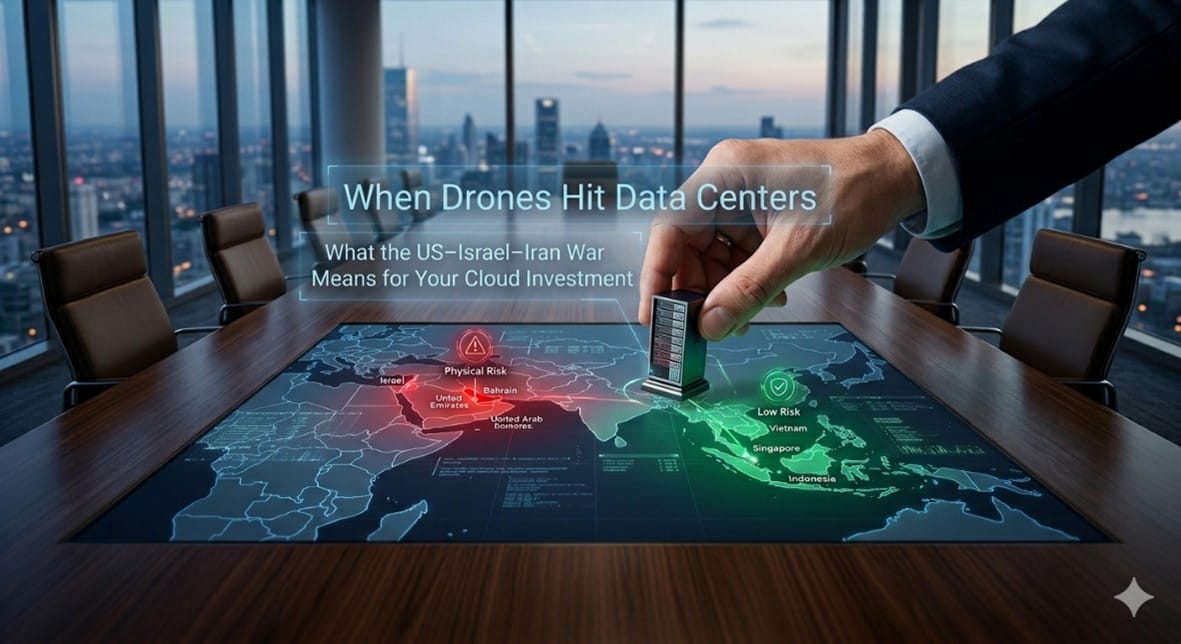
What the US–Israel–Iran War Means for Your Cloud Investment
The first physical attacks on hyperscale cloud infrastructure just rewrote the rules of geopolitical risk.
Before dawn on March 1, 2026, Iranian Shahed drones struck two Amazon Web Services data centers in the United Arab Emirates. A third AWS facility in Bahrain was damaged by debris from a nearby strike the same morning.
Source: The Conversation, April 1, 2026; CNBC, March 4–5, 2026
These were not cyberattacks. These were physical buildings, housing servers, cooling systems, fiber interconnects, and the workloads of thousands of businesses, hit by weapons of war. It was the first confirmed kinetic attack on a major American hyperscaler’s infrastructure in history.
Source: Rest of World; InfoQ, March 2026
If your organization has invested in cloud infrastructure, or is planning to, this is not a story you can scroll past. This is a business continuity story, and it demands a serious strategic response.
3
AWS facilities struck UAE & Bahrain
29
AWS facilities struck UAE & Bahrain
−1pp
AWS facilities struck UAE & Bahrain
+70%
AWS facilities struck UAE & Bahrain
FACT CHECK:
The original article stated IDC cut its 2026 global IT growth forecast “from 6.8% to 4.5%.” This is incorrect. IDC’s pre-war baseline for 2026 global IT spending growth was approximately 10%. In its conflict scenario published March 2026, IDC projected a downside cut of roughly one percentage point globally (to ~9%), with MEA-specific growth falling from a 5% baseline to 3–4% in a short-conflict scenario. The “6.8% to 4.5%” figures do not appear in any IDC source. (Source: IDC, “First Look at the War in the Middle East and Its Impact on IT Spending,” March 2026)
WHAT HAPPENED
The attack that changed everything
Iran’s Islamic Revolutionary Guard Corps claimed responsibility for the strikes. Its stated reason was to expose the role of these facilities in “supporting the enemy’s military and intelligence activities.” The Bahrain strike hit a drone target near the AWS facility, causing structural impact rather than a direct hit on the building. Both UAE sites took direct hits.
Source: CNBC citing Fars News Agency, March 4, 2026; The Conversation, April 1, 2026
On March 11, an IRGC-affiliated news outlet (Tasnim News Agency) published a list of 29 tech targets Iran plans to strike. The list covers facilities across Bahrain, Israel, Qatar, and the UAE. It includes five AWS data centers, five Microsoft, six IBM, three Palantir, four Google, three Nvidia, and three Oracle facilities.
Source: Center for Strategic and International Studies (CSIS), “Data Is Now the Front Line of Warfare,” March 2026
NAMED TARGETS ON IRAN’S PUBLISHED LIST (March 11, 2026)
Five AWS, five Microsoft, six IBM, three Palantir, four Google, three Nvidia, and three Oracle facilities across Bahrain, Israel, Qatar, and the UAE were explicitly listed by an IRGC-affiliated outlet. These are publicly declared strategic intentions, not speculation. Source: Center for Strategic and International Studies (CSIS), March 2026
The strikes disrupted regional banking systems, severed cloud services for downstream businesses, and forced every hyperscaler operating in the Gulf to reassess its risk position. Abu Dhabi Commercial Bank, Emirates NBD, First Abu Dhabi Bank, payment platforms Hubpay and Alaan, data cloud firm Snowflake, and ride-hailing platform Careem all reported outages.
Source: TechPolicy.Press; Fortune, March 2026
Before the attacks, the UAE’s data center market was projected to grow from $3.29 billion in 2026 to $7.7 billion by 2031, according to data analytics firm Mordor Intelligence. That trajectory is now in question.
Source: Euronews citing Mordor Intelligence, March 12, 2026
“Data centres are a critical building block of AI capabilities at the national level. From that perspective, data centres can be considered a very critical infrastructure.”
— Vincent Boulanin, Director, Governance of AI Programme, Stockholm International Peace Research Institute (SIPRI) — Euronews, March 12, 2026
What makes this alarming is not only the physical destruction. It is the precedent. As CSIS wrote plainly: there are no front lines anymore. Industry and warfare have collided in the server room.
Source: CSIS, “Data Is Now the Front Line of Warfare,” March 2026
THE STRATEGIC FALLOUT
Three shifts cloud investors must understand now
1. Geography is now a first-class risk variable.
For years, cloud strategy turned on latency, compliance, and cost. Geopolitical location was an afterthought. That era has ended.
IDC’s pre-war baseline for 2026 global IT spending growth was approximately 10%. In its conflict impact assessment published in early March, IDC modeled a downside scenario where a conflict lasting up to three months cuts global IT growth by roughly one percentage point, pushing growth to approximately 9% globally. For the Middle East and Africa region specifically, the baseline growth forecast of 5% could drop to 3–4%. Capital deployment across the Gulf region has frozen.
Source: IDC, “First Look at the War in the Middle East and Its Impact on IT Spending,” March 2026; IDC, “Stress-Testing the Digital Economy,” March 2026
2. Your cloud provider’s government contracts are now your problem.
The reason Iran targeted AWS is instructive. Iranian state media claimed the strikes targeted facilities supporting US military AI systems, including Anthropic’s Claude, which the US military was reportedly using for intelligence analysis and war simulations. AWS has declined to confirm or deny those specific claims.
Source: Fortune, March 9, 2026; TechPolicy.Press, March 2026
US law normally requires cloud providers to store government and military data inside the US or on Department of Defense bases. Researchers at Just Security noted on March 12, 2026, that it was unclear whether special authorization had been granted for Gulf-based military workloads.
Source: Just Security, March 12, 2026, as cited in The Conversation, April 1, 2026
When private hyperscalers embed with state militaries, their commercial customers inherit the geopolitical exposure. Your CRM database may sit in the same facility as a defense AI workload. An adversary state may not distinguish between the two.
3. Standard insurance and SLAs will not protect you.
Most commercial property and business interruption insurance policies explicitly exclude acts of war. Cloud SLAs are similarly unlikely to cover kinetic strikes. Legal analysis from TechPolicy.Press warns that without bespoke military disruption clauses in contracts, tech providers face full liability for sunk costs, with virtually no recourse against state actors.
Source: TechPolicy.Press, “The Legal and Policy Fallout from Data Center Strikes in the Middle East War,” March 2026
“The cloud has become the modern telegraph cable. If operating in the Gulf carries such immense physical risk, why do hyperscalers concentrate so much critical infrastructure there?”
— TechPolicy.Press, March 2026
WHAT THIS MEANS FOR YOU
Practical guidance for cloud invested organizations
Whether you run mission-critical workloads on AWS, are scaling on Azure, or are a board evaluating a multi-million-dollar data center commitment, here is the framework I am walking every client through now.
• Audit your cloud regions against current conflict zones and Iran’s published target list.
• Review your SLA force majeure clauses. Most do not cover kinetic warfare.
• Demand war-risk insurance. Standard policies exclude armed conflict.
• Build multi-region, multi-provider architectures. Single-region deployments are now high-risk.
• Evaluate politically stable regions: Singapore, Japan, the EU, and South Asia as alternatives.
• Where possible, decouple from fossil-fuel-dependent data center power chains.
STRATEGIC ACTIONS WORTH TAKING NOW
Prioritize geographic diversity across geopolitical blocs. Multi-cloud is no longer only about vendor lock-in. Accelerate the move to renewable-powered infrastructure. The EU estimates gas prices rose 70% as Hormuz traffic stalled, directly raising data center operating costs across gas-dependent grids. (Source: Euronews citing EU data, March 31, 2026) Engage legal counsel on war-risk clauses in existing cloud contracts. Build explicit “conflict response” runbooks into your disaster recovery plans, with tested failover to regions outside conflict-adjacent geographies.
THE BIGGER PICTURE
A word to organizations planning new cloud investments
If you are committing capital to cloud infrastructure right now, whether building your own data center, signing a long-term hyperscaler agreement, or migrating legacy systems, pause and pressure-test the geography of that investment. The Gulf was the most exciting cloud market in the world two months ago. Today it carries a risk profile no sales deck prepared you for.
From my position in Sri Lanka, sitting between the Middle East and Southeast Asia, I see both the threat and the opportunity clearly. South Asia and Southeast Asia are politically stable, latency-favorable for vast populations, and increasingly home to world-class data center capacity. They do not appear on any nation-state’s current target list.
The lesson of March 2026 is not that the cloud is broken. The cloud remains the most powerful computing platform in modern history. The lesson is that geography, geopolitics, and risk architecture can no longer be delegated to a vendor’s sales deck. They belong at the boardroom table.
“Industry will do what it can to protect its people and clients’ data. The beauty of the cloud is that data can move. But data centers cannot move, and tech companies are still just companies.”
— Center for Strategic and International Studies (CSIS), “Data Is Now the Front Line of Warfare,” March 2026
As cloud professionals, this is our moment to lead with clarity. Our clients need more than infrastructure advice. They need a geopolitical risk framework built into every architecture decision.
We are actively working with organizations across Asia on exactly this. If your cloud strategy has not been stress-tested against the world we are now living in, let’s talk.