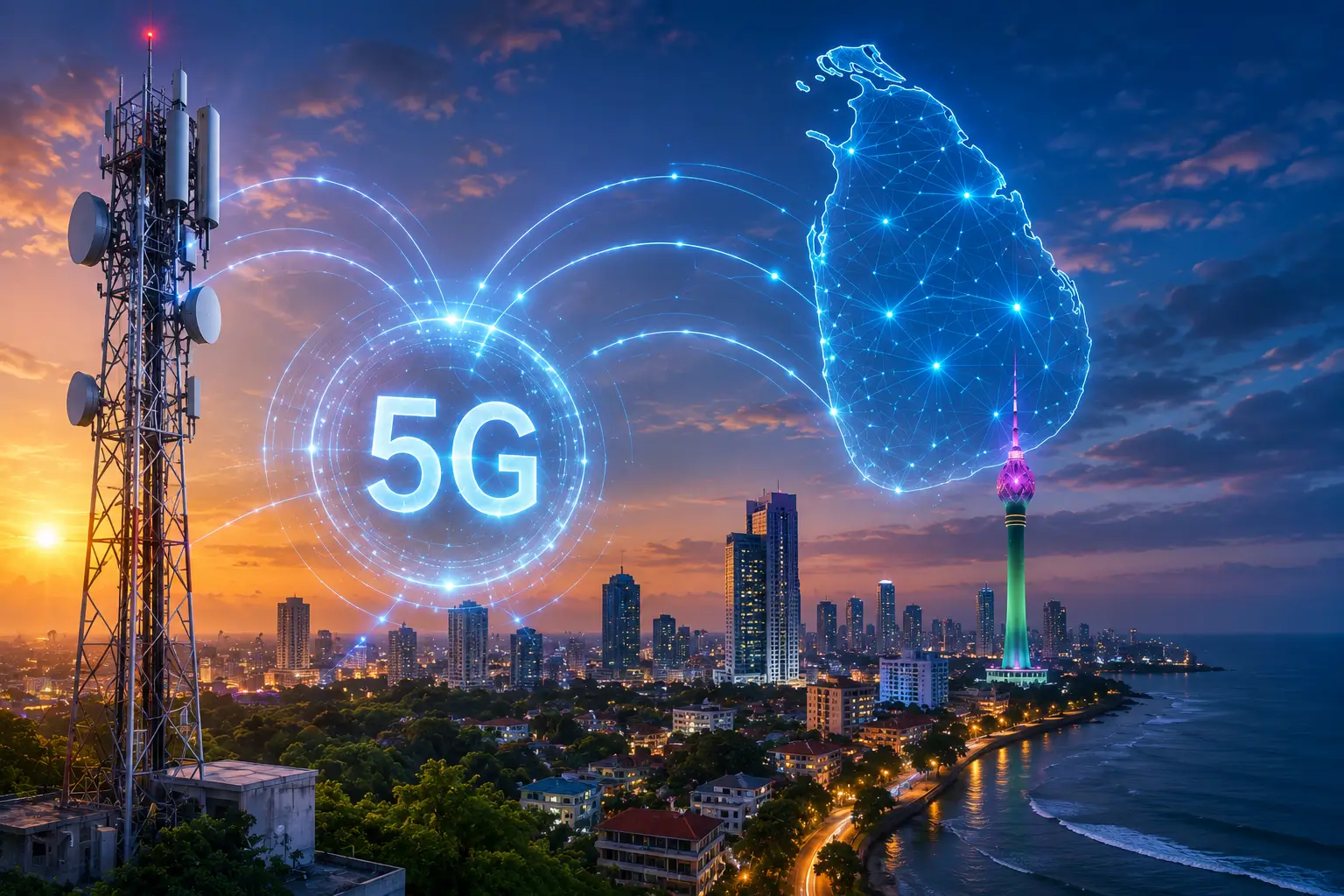
The telecommunications industry is undergoing a significant transformation driven by two groundbreaking technologies: Artificial Intelligence (AI) and Fifth Generation (5G) mobile networks. These technologies are changing the way communication networks are designed, managed, and optimized. AI and 5G integration offer Sri Lanka a special chance to bolster digital infrastructure, enhance service quality, promote economic growth, and quicken the nation’s digital transformation goal.
As demand for high-speed connectivity, cloud services, video streaming, and Internet of Things (IoT) applications continues to grow, telecom operators face increasing challenges in maintaining network performance and customer satisfaction. The complexity of contemporary telecommunications networks is making traditional network management techniques less effective. Innovative solutions made possible by AI and 5G allow for intelligent, automated, and extremely effective network operations.
The Current Telecommunications Landscape in Sri Lanka
Over the past 20 years, Sri Lanka has made significant advancements in telecommunications. The nation’s connectivity has been greatly enhanced due to the extensive installation of broadband services, fiber-optic infrastructure, and mobile networks. Businesses, governments, educational institutions, and individuals now depend on telecommunications services.
However, several challenges remain. The industry is nevertheless impacted by network congestion brought on by increasing data consumption, operational inefficiencies, expanding maintenance costs, cybersecurity issues, and the requirement to extend coverage to rural areas. Telecom operators must implement technologies that improve network intelligence and efficiency while meeting future digital needs in order to overcome these obstacles.
Understanding 5G Technology
5G is the latest generation of mobile communication technology, offering substantial improvements over previous generations. It delivers faster data speeds, lower latency, greater reliability, and increased network capacity.
The capacity of 5G to accommodate numerous connected devices at once is one of its main benefits. As IoT applications proliferate, this feature becomes even more crucial. 5G networks enable effective communication between smart devices, sensors, industrial machinery, and autonomous systems.
Ultra-low latency, which allows for communication in almost real time, is another important aspect. Applications including industrial automation, public safety services, smart transportation systems, and remote healthcare are supported by this. 5G’s higher speed and capacity also enhance user experiences in digital entertainment, cloud computing, online education, and video conferencing.
For Sri Lanka, 5G provides the technological foundation necessary to support smart cities, digital businesses, and emerging technologies that require reliable high-speed connectivity.
Check out Part 2, where we explore the role of Artificial Intelligence in telecommunications and how AI is revolutionizing network operations.
Thilina Molligoda – Strategic Architect – Defense and Telco